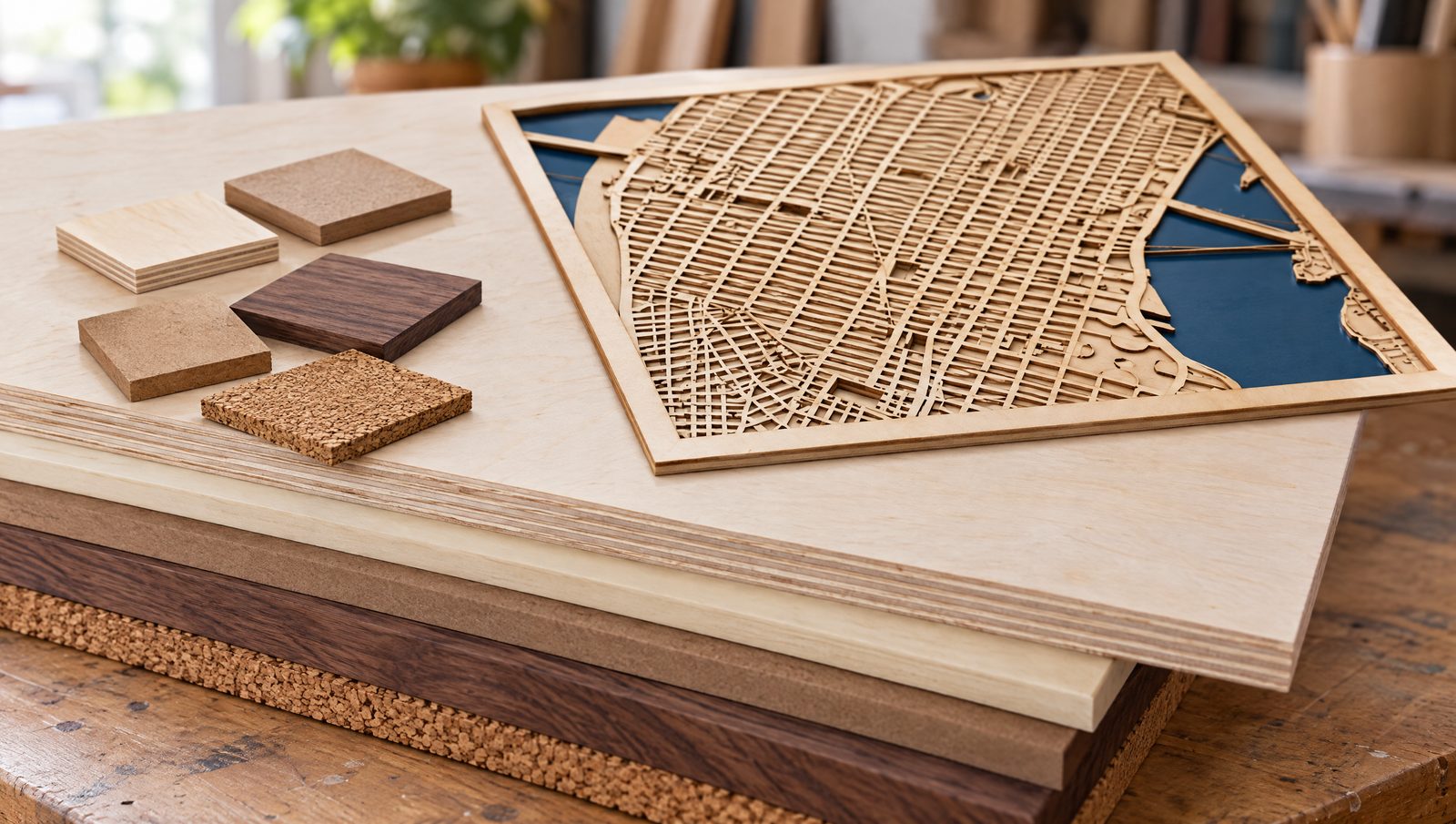
Transparency: some links in this guide are affiliate links. If you buy through them, Maperivo may earn a commission at no extra cost to you. It does not change what we recommend.
Most failed plywood cuts are not a settings problem. They are a glue, void or moisture problem, and you can spot most of them before the sheet goes on the bed. Here is what to buy for a diode and for a CO2 laser, how to test a sheet in the shop, and what laser plywood really costs in Poland, Germany and the US.
Quick answer
- Diode laser: thin laser-grade birch, poplar or basswood plywood with interior glue. Very pale, high-grade faces can engrave worse on a diode.
- CO2 laser: the same plywood, thicker if needed. MDF cuts cleanly too, with dark edges, and its glue can release formaldehyde.
- Avoid: exterior, marine and WBP plywood. Phenolic glue shows as dark lines on the edge and can stop the beam dead.
- Test every batch: sheets of the same thickness cut differently because of glue, moisture and voids (Thunder Laser).
- Compare per m²: in our check a laser-branded A3 pack cost almost three times more per m² than a merchant's 600×400 mm sheet of 3 mm poplar.
Which wood works on a diode and which on a CO2?
For wood, the laser type matters less than for acrylic: both a blue diode (450 nm) and a CO2 laser (infrared, around 10.6 µm) cut and engrave plywood. The differences are power, speed and how the surface reacts. On the LightBurn forum, a maker with a 10 W diode reported poor engraving on a whiter, higher-grade plywood that looked "amazing" when engraved with a CO2. The explanation given there: a whiter surface reflects more of the diode's visible light.
| Material | Blue diode | CO2 | Watch out for |
|---|---|---|---|
| Laser-grade birch plywood | Cuts thin sheets, engraves | Cuts and engraves | Glue pockets and voids in inner plies |
| Poplar plywood | Cuts easily | Cuts easily | Knots possible in the middle layer |
| Basswood plywood | Cuts | Cuts | Thickness claims come from brands only |
| Exterior, marine, WBP plywood | Avoid | Avoid | Phenolic glue: dark glue lines, char, uncut spots |
| MDF | Thin sheets, several passes | Up to 15 mm (Trotec) | Formaldehyde glue, dark edges, banned in some labs |
| Alder, cherry, maple, walnut | Engrave | Engrave | Best engraving contrast; sources disagree on alder |
| Pine, cedar, spruce | Uneven engraving | Uneven engraving | Resin: smoke and inconsistent burn |
| Oak | Grainy result | Grainy result | Open grain |
| Veneered board | Engrave; no cut data | Cut at 30 W+ (Trotec) | The core decides the cut |
Summary of the sources below. Thickness figures are manufacturer claims.
Why does the glue decide whether plywood cuts?
Plywood is "at least three layers of wood whose grain is glued and pressed at an angle of 90°" (Trotec), and the beam has to burn through every glue line. Trotec's advice: "Choose white-glued plywood panels or plywood panels made specifically for laser processing." Glowforge adds that some plywood glue is simply not laser-compatible.
The clearest numbers come from Nervous System, a design studio that tested plywood for laser-cut puzzles in 2014. Phenolic exterior glue needed about four times more laser power than urea-based interior glue, and some glues contained metal flakes. The studio rejected about half of one supplier's sheets for voids and knots and ended up with a custom 5 mm, 3-ply sheet: basswood core, birch faces, melamine-based glue.
| Glue type | Typical use | Laser verdict | What the sources say |
|---|---|---|---|
| Urea-formaldehyde (UF) | Interior plywood; most MDF | Cuts | "quite ok" (Lasersaur wiki). Sklejka-Kraków and M2CreativLab sell UF-glued laser birch. |
| Melamine-formaldehyde (MF), MUF | Interior and laser plywood | Recommended | MF "recommended", MUF "quite ok" (Lasersaur); Nervous System chose melamine glue. |
| PVA | Interior wood glue | Cuts | "produced no harmful chlore based gases" (Lasersaur). |
| Phenol-formaldehyde (phenolic) | Exterior, marine, WBP plywood | Avoid | About 4× the power (Nervous System); the CO2 lasers of The Laser Co cannot cut exterior or marine ply; prohibited by Stanford EHS. |
| Resorcinol- and melamine-phenol-formaldehyde | Weatherproof bonds | Avoid | "quite problematic", "NOT recommended!" (Lasersaur). |
Lasersaur is an open-source laser wiki, Nervous System a design studio. Neither is a test lab, but both match Trotec, Stanford EHS and the cutting services.
Laser-friendly does not mean fume-free: the University of Florida's safety office notes that plywood and MDF adhesives "may give off fumes such as formaldehyde gas". Run your extraction every time.
How can you spot bad plywood in the shop?
Test 1: the colour of the glue lines
Look at the edge. The Laser Co, an Australian cutting service, says exterior plywood shows "black / dark glue lines", interior plywood "clear / invisible glue lines", and its CO2 lasers "are unable to successfully cut through exterior grade, marine grade or structural grade plywood." The German seller Lasersheets.de agrees: aircraft plywood with exterior (WBP) glue leaves black, sooty edges, its laser-glue birch honey-brown ones.
Do not trust the label alone. On the LightBurn forum, a maker with a 50 W CO2 cut 4 mm Baltic birch at 10 mm/s; the next batch needed about 2 mm/s. Both were sold as WBP. The old batch had nearly invisible glue lines, the new one dark brown ones, and the laser "stopped dead" at the glue layer. Replies traced it to phenolic resin.
Test 2: faces, voids and knots
The Lasersaur wiki: "You need sanded surfaces with absolutely no knots or holes. Holes will be filled with glue, and that will stop the laser beam!" In another LightBurn thread the uncut areas were "patches of glue in the inner plies"; knots are denser than the wood around them. Grades help: Lasersheets' B/B birch has no knots on the outer layers, while Mr Beam warns its AB/B poplar may have branches in the middle layer.
Why this matters for maps: a street layer is one sheet with many small city blocks between the streets. One hidden glue pocket leaves a block hanging or scorched, and you find it only when you lift the layer.
- Edge: clear or pale glue lines, not black or dark brown.
- Faces: no knots, holes or filler patches where you will cut.
- Glue: ask. Shops that state it name UF glue (Sklejka-Kraków, M2CreativLab), a white glue line (FEINSCHNITTkreativ) or a laser glue (Lasersheets).
- Flatness and a test cut from each new batch (see the routine at the end).
Polish shops list "suchotrwała" (dry-use) and "wodoodporna" (waterproof) plywood. Treat waterproof sheets like exterior plywood until the shop names the glue.
Birch, poplar or basswood plywood: what changes?
Thunder Laser describes birch as having a "smooth surface, fine grain, and relatively consistent structure", poplar as "lightweight, easy to cut", and eucalyptus as needing more power, slower speed or several passes. Basswood appears as a core in the Nervous System sheet. xTool claims its 20 W diode cuts up to 10 mm basswood plywood and lists 18 mm poplar plywood in 6 passes on its 40 W diode.
For layered work, consistency beats everything: buy all layers for one piece from one batch.
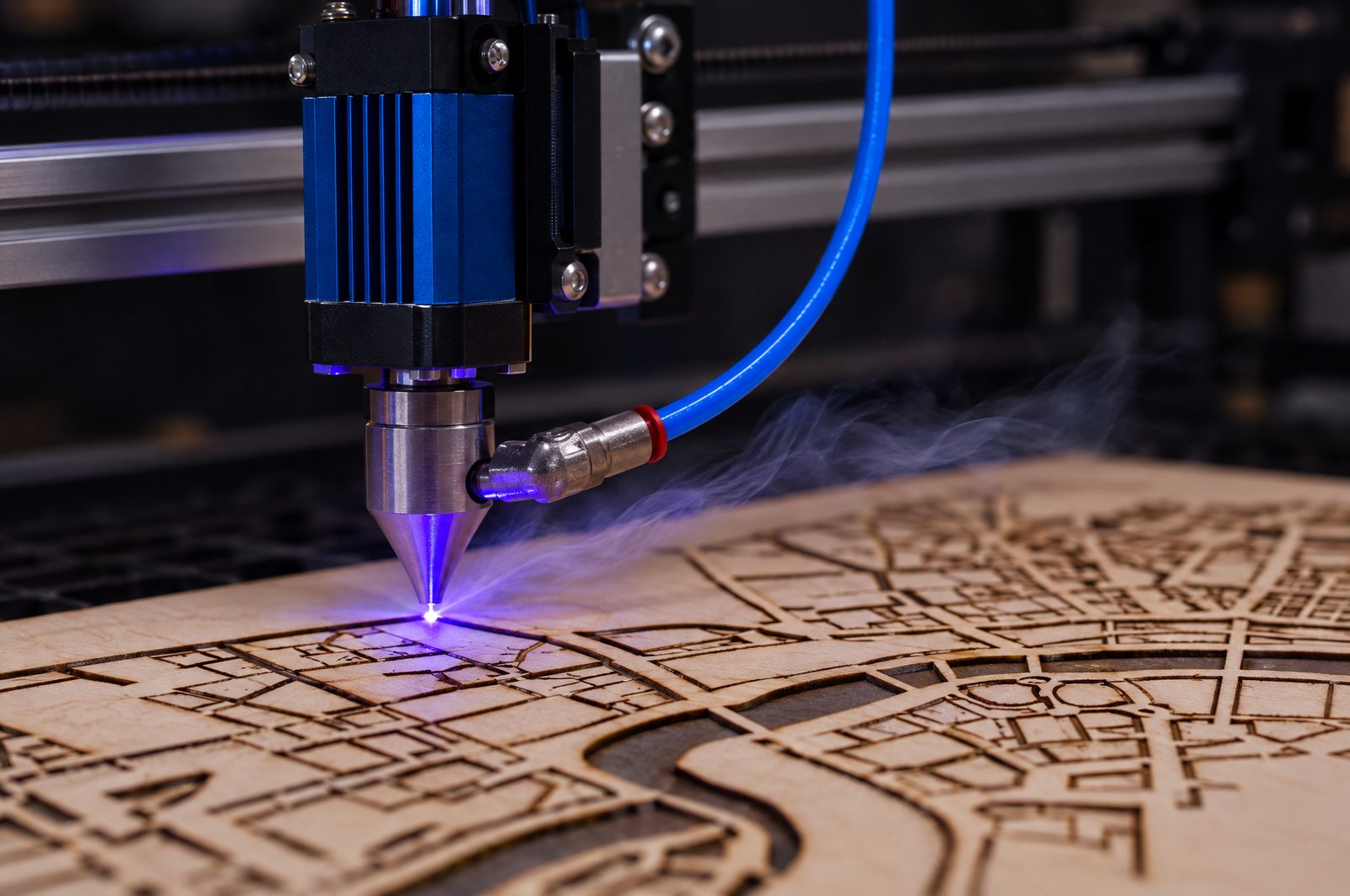
We use both species. Our cut-out city maps are cut from 6 mm A-grade Baltic birch plywood, painted black, natural or white. Our 3D maps are layers of poplar plywood in a frame of solid pine, hand-waxed. We cut on an xTool P3 (80 W CO2, 915×458 mm bed) and a Sculpfun S30 (33 W) diode. See a finished birch cut-out map and how the poplar layers stack in Viperys Wall Art, our own shop.
Is MDF safe to laser?
MDF has a uniform fibre structure, so it cuts evenly. Trotec says it cuts "up to 15 mm in a good quality", is "best cut with a CO2 laser at 30 watts or higher", and that its dark edge "is used as a design element in many cases". The problem is the binder. Mount Sinai's occupational medicine unit writes that MDF glue is "usually urea formaldehyde (UF)" and that such MDF "may emit formaldehyde gas for months or years".
Institutions disagree. The UW CSE Fab Lab bans MDF; Emory bans formaldehyde MDF and HDF ("Formaldehyde is a carcinogen."); the University of Georgia approves MDF up to 1/2 inch; Lancaster Makerspace allows only sheets that are "explicitly laser-safe". Read this as caution, not one rule.
| Composite wood product (US) | Formaldehyde emission limit |
|---|---|
| Hardwood plywood | 0.05 ppm |
| Particleboard | 0.09 ppm |
| MDF | 0.11 ppm |
| Thin MDF | 0.13 ppm |
EPA TSCA Title VI final rule (Federal Register, 12 Dec 2016); labels required since 22 March 2019; limits identical to California's CARB rules. CARB says emissions before the rules were often ten to twenty times higher. We did not verify EU or German limits, so we do not quote them.
These limits cover slow off-gassing at room temperature. They say nothing about what the beam releases when it burns the board. That is our reading of the rules, not a test result: treat every MDF and plywood as a fume source.
Which solid woods, veneers and specialty sheets engrave best?
Epilog calls alder, cherry and maple "widely considered the best woods for laser engraving": "fine-grain, low-resin" woods. "High-resin woods like pine, cedar, and spruce tend to burn inconsistently and produce excessive smoke." Its settings whitepaper adds walnut, calls oak "much grainier" and advises engraving with the grain parallel to the X stroke. Trotec says hardwoods need more power but give more contrast, and calls coniferous woods "not suitable for laser engraving" because of uneven grain.
Where sources disagree: Thunder Laser calls alder "the most laser-compatible wood for engraving", while Thunder Laser USA, writing about cutting, says alder has a "high resin content" and is "much more likely to scorch or have a dark-edged finish". We found no measured contrast figures, so test on an offcut.
- Veneer: engraves like solid wood (Trotec). Trotec's veneered board has a formaldehyde-free fibreboard core and needs "a CO₂ laser of 30 watts or more" to cut.
- Cork: engraves "dark and produces an attractive contrast" at low power (Trotec); quality depends on thickness and binder (ATX, Dallas Makerspace).
- Bamboo: laminated strips "may engrave at different shades", and bamboo "should not be left unattended" (Thunder Laser).
How thick can a diode or a CO2 really cut?
Every figure below is a claim, a listing or a workshop rule. We found no independent test of a diode and a CO2 on the same plywood.
| Machine or rule | Claimed plywood cut | Type of source |
|---|---|---|
| 5 W diode (LightBurn forum, 2022) | 3 mm craft plywood: slowed down, 3 passes | Community report |
| 10 W optical diode (reseller listing) | 3 mm at 480 mm/min, 6 mm at 180 mm/min, 1 pass, 100% power, air assist | Reseller claim |
| xTool M2, 20 W diode | Up to 10 mm basswood plywood | Manufacturer claim |
| xTool 40 W diode | 15 mm plywood in one pass (S1); 18 mm poplar plywood in 6 passes | Manufacturer claim |
| xTool P2, 55 W CO2 | 18 mm plywood in one pass | Manufacturer claim |
| xTool P3, 80 W CO2 | Wooden board up to 20 mm | Manufacturer FAQ |
| Trotec CO2 systems | Plywood and MDF up to 15 mm | Manufacturer |
| ATX Hackerspace / Purdue BIDC | Up to 1/4 in / 0.5 in ("cabinet plywood required") | Workshop rule |
xTool also claims its CO2 is "almost 500% quicker" than its 40 W diode on plywood. Brand figures assume ideal, laser-grade sheets.
For thin map layers of 3 to 6 mm, the limit is rarely the question; speed, passes and edge char are. See our diode laser tips, CO2 laser tips and how to prevent burn marks.
How do moisture and storage change the cut?
Trotec: "The drier and more resin-free the wood, the brighter the cutting edge." Moisture also bends sheets, and Glowforge notes warped material "may not yield consistent cuts" and Craft Closet adds that parts of the design then end up out of focus. The US Forest Products Laboratory gives the physics: wood settles at an equilibrium moisture content (EMC) set by the air. At 21.1 °C that is 6.2% at 30% relative humidity, 9.2% at 50% and 12.0% at 65%. Wood moves most tangentially, about half as much radially, and only 0.1–0.2% along the grain.
The same handbook says wood should be used at a moisture content "as close as possible to the average moisture content it will experience in service", and that wood in humid storage regains about 2% moisture per month over the first 45 days. Store sheets flat, indoors, in the room where you cut. Warping after assembly is covered in layered laser art: glue, alignment, kerf and warping.
What does laser plywood cost in Poland, Germany and the US?
Shelf prices from real shop pages; the per-m² column is our own arithmetic. Shipping is extra.
| Shop | Sheet | Price | Per m² (our calc) |
|---|---|---|---|
| Sklejka-Kraków (PL) | Birch 3 mm, class 1, 600×400 mm | 11.21 zł | 46.71 zł |
| Sklejka-Kraków (PL) | Birch 3 mm, class 1/2, 1525×1525 mm, free cut into 2–4 pieces | 80.07 zł | 34.43 zł |
| Drecon-Sklejka (PL) | Birch 3 mm, class 1/2, 400×400 mm | 7.34 zł | 45.88 zł |
| Zembrod Sperrholz-Shop (DE) | Poplar 3 mm, A/A, laser-suitable, 600×400 mm | €4.30 incl. 19% VAT | €17.92 |
| Lasersheets.de (DE) | Birch 3 mm, B/B, laser glue, 120×60 cm | €23.50 net | €32.64 net |
| Mr Beam (DE) | Poplar 3 mm, AB/B, A3, pack of 5 | €31.90 incl. VAT | €51.15 |
| M2CreativLab (AT) | Birch 3 mm, UF glue, 500×300 mm, 20 pieces | €75.60, no VAT charged | €25.20 |
| MakerStock (US) | Baltic birch 1/8 in, 12×20 in | $3.79 | $24.48 |
| Woodpeckers (US) | Baltic birch 3 mm, 12×20 in, pack of 6 | $29.36 | $31.60 |
| LaserGrain (US) | Baltic birch 3 mm, 11.8×19.8 in, pack of 5 | $57.95 | $76.89 |
Prices as of 24 September 2026. The Polish shop pages do not say whether VAT is included. MateriałyLaser.pl shows 29.90 PLN on a 600×300 mm sheet labelled "price per 1 m²"; the unit is unclear, so we left it out. FEINSCHNITTkreativ sells white-glue laser birch in 4-sheet packs for €16.90–€33.00.
Three lessons. The format matters as much as the shop: Sklejka-Kraków's full sheet costs 34.43 zł per m², its 600×400 format 46.71 zł (class 1/2 vs class 1 faces). Laser-branded packs are convenient but pricey: Mr Beam's A3 pack works out at about €51 per m², almost three times Zembrod's €18. And bigger is not always cheaper: MakerStock's 24×48 in sheet ($31.99) is about $43 per m². Check that pieces fit your bed: 600×400 mm fits the xTool P3's 915×458 mm bed, a 1525×1525 mm sheet must be cut down first. For what material means for your selling price, see laser product prices and margins.
A test routine before a big job
- Check the sheet: glue lines, faces and flatness.
- Let it settle flat in the workshop, and hold it flat on the bed: honeycomb pins "apply gentle pressure" (Craft Closet).
- Run a material test: LightBurn's Material Test "creates a grid of test boxes with varying parameters", fastest and weakest first. Keep units consistent (mm/min vs mm/s).
- Cut a real feature: for maps, export a small crop of the real street layer from the Maperivo Laser Map Designer. Thin streets and tiny blocks reveal glue pockets that a test square hides.
- Repeat per batch: "even sheets with the same thickness may perform differently" (Thunder Laser).
Map settings are in LightBurn settings for laser maps; acrylic water layers and other materials in the best wood and materials for laser maps.
Sources
Checked 24 September 2026. Every page below was opened and read. Brand pages are marked as claims in the text; forum posts are reported as individual experiences; per-m² prices are our own arithmetic from the listed price and sheet size.
- Trotec — Wood: material handling tips
- Trotec — Laser cutting plywood; Laser cutting MDF; Veneered wood; Cork
- Lasersaur wiki — Choosing the right plywood to laser cut
- Nervous System — plywood testing for laser-cut puzzles (9 Oct 2014)
- The Laser Co — Interior vs exterior grade plywood (7 Feb 2017)
- LightBurn forum — New batch of ply won't cut (Oct 2024); Tough spots in cutting plywood (Jan 2020); Consistency of cutting 3 mm plywood (May 2022); More passes or more power? (Apr 2021)
- LightBurn forum — Whiter plywood not good for diode laser (8 Oct 2023)
- Glowforge — Custom materials FAQ; Cut didn't go through material
- Thunder Laser — Plywood guide; Best wood for laser engraving (19 May 2025); Bamboo (28 May 2026)
- Thunder Laser USA — Preventing burning when laser cutting (19 Dec 2020)
- Epilog — Wood engraving; Settings whitepaper
- Stanford EHS — Laser cutters safety guidance (rev. 26 Sep 2024); University of Florida EHS — Laser cutter materials
- Mount Sinai Occupational Medicine — MDF for carpenters
- Makerspace and university material lists: UW CSE Fab Lab; Emory TechLab; UGA; Lancaster Makerspace (12 May 2024); ATX Hackerspace; Dallas Makerspace; Purdue BIDC
- US EPA — Formaldehyde emission standards for composite wood products
- Federal Register — Formaldehyde emission standards, final rule (12 Dec 2016); CARB — Consumer FAQ
- xTool — Laser cutting plywood (updated 15 Jun 2026); xTool 40 W test results; xTool P3 FAQ
- Geekbuying — 10 W diode engraver listing
- USDA Forest Products Laboratory — Wood Handbook, ch. 4; ch. 12
- Craft Closet — Honeycomb pins (31 Mar 2021); LightBurn docs — Material Test
- Polish shops: Sklejka-Kraków 600×400; Sklejka-Kraków full sheet; Sklejka-Kraków laser sheet (UF glue); Drecon-Sklejka; MateriałyLaser.pl
- German and Austrian shops: Zembrod Sperrholz-Shop; Lasersheets.de birch; Lasersheets.de collection; Mr Beam; FEINSCHNITTkreativ; M2CreativLab
- US shops: MakerStock; Woodpeckers; LaserGrain