Transparency: some links in this guide are affiliate links. If you buy through them, Maperivo may earn a commission at no extra cost to you. It does not change what we recommend.
Acrylic is the friendliest plastic a laser can cut, and some of its neighbors on the plastics shelf are among the most dangerous. This guide sorts plastics into safe, caution and never, shows what changes between a diode and a CO2 laser, and names the source behind every line, including the places where manufacturers and university safety offices disagree.
Quick answer
- Safe: cast and extruded acrylic (PMMA). A CO2 laser cuts every color; a blue diode cuts only opaque colors such as red, orange, yellow, green and black.
- Caution: PETG, POM (Delrin), PP, PE and some foams. Lab policies disagree, so ventilate well and read the safety data sheet.
- Never: PVC and vinyl, ABS, polycarbonate, PTFE (Teflon), PVB, polystyrene foam, fiberglass and coated carbon fiber. The danger is the gas or the fire, whatever the laser.
- Brand lists are not safety rules: xTool's P3 FAQ lists PVC and ABS as processable, while xTool's own plastics safety guide calls both unsafe.
- Unknown plastic? No data sheet, no laser.
Which plastics are safe to laser cut?
The table is the short version of this article. "Never" means never in a hobby or small-workshop setup, on a diode or a CO2: the toxic gas comes from the material, not from the laser type. "No data" means we found no source on how a diode handles that material.
| Material | Verdict | Diode (450 nm) | CO2 | Main problem | Sources |
|---|---|---|---|---|---|
| Cast acrylic (PMMA, GS) | Safe | Opaque red, orange, yellow, green, black only | All colors | Fumes need extraction; keeps off-gassing for a day or more | Epilog, Darkly Labs, Harvard GSD |
| Extruded acrylic (XT) | Safe | Same color limits | All colors | Crazes with alcohol, bleach or ammonia cleaners | Epilog, Trotec, CutLaserCut |
| PETG | Caution | Not clear sheet (forum report) | Cuts with a polished edge | Heats up; space parts 5 mm apart | CutLaserCut, UW, UGA, Pinside forum |
| POM (Delrin) | Caution | No data | Policies split | Formaldehyde | Dallas, UGA vs UW, Lancaster, Emory |
| PP, PE (sheet, film) | Caution | No data | Melts | Gooey melt, burning drips | UGA, Emory, ATX |
| PE, PES, PU foams | Caution | No data | Cuts with sealed edges | Fire; confirm the foam type | Trotec, Michigan |
| EVA foam | Sources conflict | No data | Allowed by Dallas, banned by UW | UW says chlorine; the formula has none: get the SDS | Dallas, UW, Wikipedia |
| PVC, vinyl, PVC foam board | Never | Never | Never | Hydrogen chloride and chlorine; corrodes the machine | MIT, Stanford, Michigan, Glowforge, Trotec |
| ABS | Never | Never | Never | Hydrogen cyanide | Michigan, ATX, Emory, Stanford, xTool |
| Polycarbonate (PC) | Never | Never | Never | Discolors, catches fire, melts instead of cutting | Michigan, UW, ATX, xTool |
| PTFE (Teflon) | Never | Never | Never | Fluorine gas and HF; fumes deadly to birds | Stanford, Trotec, UW |
| PVB | Never | Never | Never | Toxic gases | Stanford, Trotec |
| Polystyrene foam | Never | Never | Never | A leading cause of laser fires | Michigan, ATX |
| Fiberglass, coated carbon fiber | Never | Never | Never | Epoxy fumes, styrene, benzene; noxious fumes | ATX, Stanford, Michigan |
Verdicts are ours for hobby and small-workshop setups, based on the sources in each row. SDS = safety data sheet. UW = University of Washington, UGA = University of Georgia, Michigan = University of Michigan EHS.
Why can't a diode laser cut clear, blue or white acrylic?
A blue diode works at about 450 nm, and acrylic has to absorb that light to melt. xTool explains that 450 nm light passes straight through clear acrylic. Darkly Labs, which makes the Emblaser diode laser, explains blue: blue acrylic looks blue because it reflects light between 450 and 500 nm, so most of the power bounces off. A CO2 laser cuts acrylic "of all colors", says xTool.
- A diode can cut opaque red, orange, yellow, green and black, plus marbled or two-layer sheet in those colors (Darkly Labs). xTool claims its 20 W module cuts 5 mm red, orange, yellow, light green and black acrylic in one pass.
- A diode cannot cut clear or tinted transparent sheet, opaque blue, pastels, or mirror acrylic with a clear base (Darkly Labs). A maker on the Bambu Lab forum reports a 40 W diode that burned and cracked clear acrylic without cutting it.
- White is disputed. xTool's support page, Darkly Labs and the Bambu Lab wiki say a diode cannot cut white acrylic; the FAQ in xTool's own acrylic guide says it can. Test a small piece of your exact sheet.
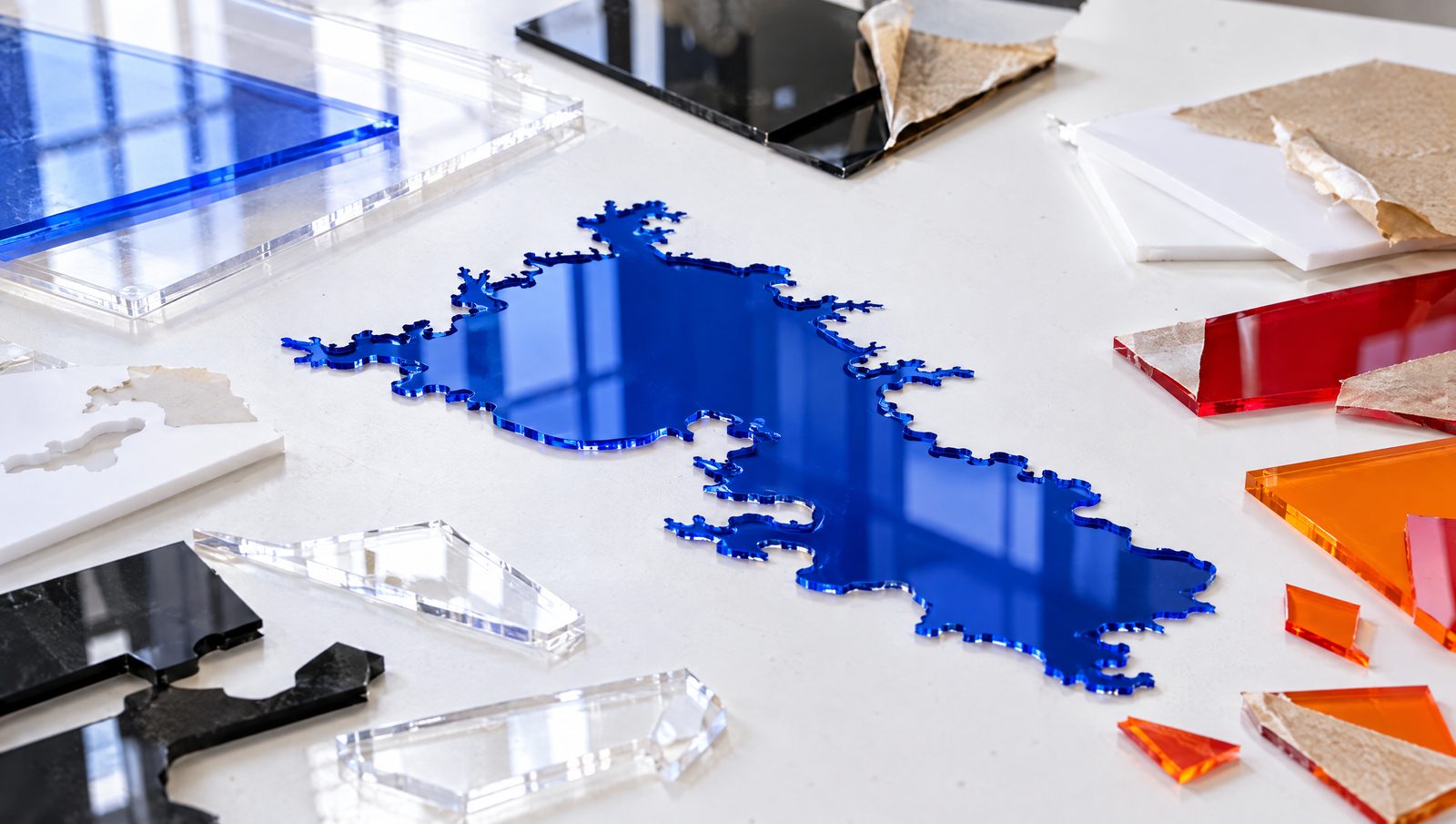
The popular workaround is disputed too. Creality suggests matte black paint, black tape or laser marking spray so a diode can cut clear acrylic. Darkly Labs says a coating only allows engraving: once the laser removes it, "the power is reflected once more; making cutting impossible". For a clean water layer, use a CO2 or an opaque color the diode can cut. Maps from our Laser Map Designer keep water on its own layer, so it can go to whichever machine suits the material; see also our diode laser tips.
We work on an xTool P3 (80 W CO2) and a Sculpfun S30 (33 W) diode. In our 3D city maps the water is not acrylic at all: it is real epoxy resin in three shades of blue, poured by hand and cured for 48 hours, over layers of poplar plywood. You can see finished pieces in the 3D epoxy maps collection of Viperys Wall Art, our own shop. If you want an acrylic water layer instead, plan it for a CO2 laser from the start.
Cast or extruded acrylic: which should you buy?
Both are PMMA; they differ in how the sheet is made, and a laser shows the difference. Trotec labels them GS (cast) and XT (extruded), which helps when you read supplier listings.
| Property | Cast (GS) | Extruded (XT) | Source |
|---|---|---|---|
| Engraving | Frosty, high-contrast white | Clear or matte gray, little contrast | Epilog, Trotec |
| Cut edge | Clean and burr-free, not flame-polished | Flame-polished, slight top/bottom difference | Epilog, Trotec (eurolaser and xTool Academy disagree) |
| Thickness tolerance | About ±15 % | About ±5 % | Trotec |
| Laser power | – | Needs less | Trotec |
| Frequency | 5,000–20,000 Hz | Up to about 5,000 Hz | Trotec (Epilog: high frequency for polished edges) |
| Internal stress | Homogeneous, stress-free | Properties differ in x and y; more prone to cracking | Trotec, CutLaserCut |
| Price | – | Typically less expensive | Epilog |
Manufacturer and supplier statements. Test your own sheet before a large order.
The edge question is the one real conflict. Epilog, Trotec and xTool's support page say extruded gives the flame-polished edge; eurolaser and xTool's Academy article credit cast. Buy one small sheet of each and cut the same test shape before ordering in bulk. Epilog notes that cast is used for almost all engraving because of its white, frosty look, so it suits an engraved map title or legend.
How thick can you cut acrylic?
Trotec's rule of thumb is about 10 W of laser power per 1 mm of acrylic, so 30 W for 3 mm. Epilog's chart says the same in steps, and with two passes an 80–100 W machine reaches 1″ (25.4 mm). xTool claims its 80 W P3 cuts up to 25 mm of transparent acrylic, and the Perspex design guide says sheet up to 25 mm can be cut, with "some experimentation" above 12 mm.
On the diode side every number is a vendor claim: xTool says its 40 W module cuts 15 mm black acrylic in one pass, and 10 mm acrylic in 6 passes against 14 on its 20 W module. For lens choice and focus on thick sheet, see our CO2 laser tips.
Should you keep the masking film on?
The sources that cover engraving agree: take the masking off the top first, or, as Epilog puts it, "you will be engraving the paper". For cutting, the sources split:
- Epilog: leave the masking on both sides when cutting.
- Trotec: paper masking on top can flame or char and damage the edges; film is easier to cut.
- Houston Acrylic (a material supplier): prefers paper, and suggests replacing plastic film with paper masking on both sides.
- xTool Academy: for cutting, paper or film can stay on.
- Bambu Lab wiki (diode context): remove the protective film completely before processing.
Our reading: there is no universal answer. Cut three strips with the same settings (film on, paper on, bare) and compare the edges.
How do you get clear edges instead of haze?
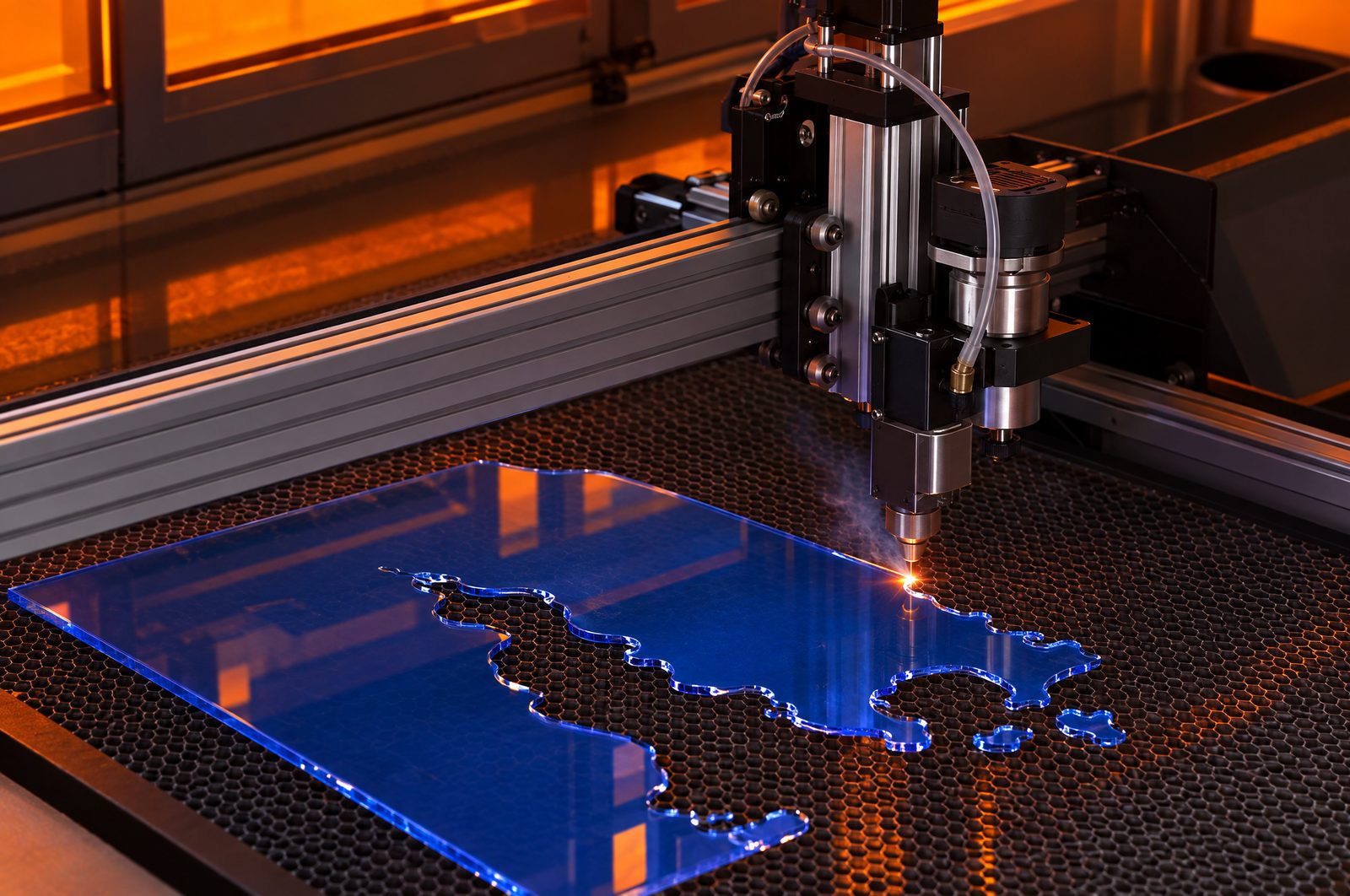
OMTech explains haze as vaporized acrylic condensing back onto the surface. Makers on Sawmill Creek describe the same frosting when the air assist and exhaust do not carry the vapor away. The fixes from the sources:
- Gentle air, not a blast. Trotec suggests moderate air assist, up to about 0.2 bar, through a large nozzle. OMTech says strong air can blow vapor back onto the part. Thunder Laser: weak air gives a clear glossy edge, strong air a bright white one.
- Lift the sheet. Epilog says raising acrylic off the cutting table greatly reduces backside reflection and grid marks. Thunder Laser recommends a knife-bar or slat table; Trotec uses spacers.
- Protect the surface. OMTech and Thunder Laser both suggest a thin layer of dish soap; OMTech also suggests paper masking on both sides, and Thunder Laser engraving from bottom to top.
- Tune frequency and speed. For a flame-polished edge Epilog pairs high power with a high frequency; Trotec suggests up to about 5,000 Hz for extruded and says slower speeds with lower power reduce waviness. The two partly conflict, so test.
- Afterwards. OMTech suggests Novus polish for leftover haze. One Sawmill Creek member found that putting parts in water right after cutting removed the fog.
How do you clean and glue laser-cut acrylic without cracks?
CutLaserCut, a UK cutting service, warns that cleaners with alcohol, bleach or ammonia will make the surface "almost certainly craze, and thin pieces may shatter completely". Trotec says alcohol can bleach colors and make the material brittle, and Thunder Laser adds that alcohol on warm, freshly cut acrylic can lead to cracks.
- Clean with water. The Perspex design guide recommends clean cold water with a little detergent and calls solvents such as methylated spirits, turpentine, white spirit or window cleaners "neither necessary nor recommended". Harvard's fab lab uses Novus 1 cleaner and polisher.
- Relieve stress before gluing. The same guide says laser cutting can leave stress around the edge; before cementing or decorating up to a laser-cut edge, a short annealing cycle reduces the risk of fine crazing. Its example: preheat the oven to 80 °C and anneal for one hour.
- Let it air out. Harvard notes that cut acrylic keeps off-gassing methyl methacrylate for a day or more, so give fresh parts time before you box them.
On a map this matters for a clear top plate or an acrylic legend glued into a frame: wipe it with soapy water, never with an alcohol wipe.
Which other plastics can you cut with care?
Outside acrylic, lab policies split. The plastics below are allowed by some safety offices and banned by others, so treat them as "caution", not "safe".
- PETG. CutLaserCut sells it in 2–6 mm and says it cuts "with a highly polished edge", but it heats up, so parts go at least 5 mm apart and deep engraving is not advised. The University of Washington and the University of Georgia approve it; Pinside forum users report that a diode will not cut clear PETG.
- POM (Delrin). Dallas Makerspace allows it ("Great for gears!") but warns of formaldehyde; UGA approves it. The University of Washington, Lancaster Makerspace and Emory ban it. Emory also names hydrogen fluoride, which no other source we opened confirms.
- PP and PE. UGA approves polypropylene and polyethylene film. Emory says polypropylene "burns and melts"; ATX Hackerspace says HDPE "melts" and "gets gooey", and that melted drops of polypropylene foam keep burning. Glowforge bans HDPE.
- Foams. Trotec says PE, PES and PU foams can be laser cut and the edges are sealed. Michigan warns that HDPE, polystyrene and polypropylene foams catch fire and melt.
- EVA foam. Dallas allows it but notes the smell and charred brown edges; the University of Washington bans it, saying it emits chlorine gas. EVA's chemical formula contains no chlorine, so the name alone cannot settle it: ask for the safety data sheet of your exact foam.
Which plastics must you never laser cut?
These are banned by the university safety offices we checked, and the reason is always what the material turns into when it burns.
- PVC and vinyl. MIT: PVC produces hydrogen chloride gas, "which is extremely dangerous". Stanford lists chlorine gas and HCl. Michigan adds that the gas ruins the optics, corrodes the machine's metal and ruins the motion control. xTool's plastics safety guide lists hydrochloric acid, vinyl chloride, ethylene dichloride and dioxin.
- ABS. Michigan: it "emits cyanide gas and tends to melt". ATX Hackerspace: hydrogen cyanide "is unsafe at any concentration". Emory, Stanford and xTool's safety guide say the same.
- Polycarbonate. Michigan: over 1 mm it "cuts very poorly, discolors, catches fire". The University of Washington: "more likely to melt than cut". Even Epilog, which says thin sheets can be cut, notes that the material tends to discolor.
- PTFE (Teflon). Stanford lists fluorine gas and HF; PTFE fumes at 300 to 450 °C cause polymer fume fever and are fatal to parrots. ATX and Dallas say thin sheets cut OK; we side with Stanford.
- PVB, polystyrene foam, fiberglass, coated carbon fiber. Stanford and Trotec rule out PVB. Michigan calls polystyrene foam "the primary material that causes laser fires nationwide". Fiberglass is glass plus epoxy resin fumes (ATX); Stanford lists styrene and benzene. Michigan says coated carbon fiber emits noxious fumes, and Stanford bans carbon fiber outright.
Where do plastics hide in other materials?
Many "never" materials arrive disguised as something else.
- Faux leather. Emory: "Artificial leathers are often made from PVC." Trotec says PVC artificial leather must not be lasered, and ATX allows "real leather only". Real leather splits too: Dallas allows vegetable-tanned leather, while Dallas, Emory and Glowforge rule out chrome-tanned.
- Rubber. Dallas allows rubber only when it is labeled "laserable" or "chlorine-free"; Emory warns that some rubbers create hazardous gases.
- Self-adhesive sheets and vinyl foams. Emory bans both; for self-adhesive sheets it warns that the glue may contain chlorine.
- Coated fabric. ATX says fabrics cut well, but "not plastic coated or impregnated cloth".
If you are tempted to back a map with PVC foam board or a self-adhesive vinyl sheet, cut the backer another way; do not put it under the laser. Our materials guide for laser maps covers the wood side.
What if a manufacturer says a plastic is fine?
Then you have found a conflict, and this guide takes the stricter side. The clearest case: when we checked on 24 September 2026, xTool's P3 FAQ still answered the question of what the P3 can process with "Wooden boards, leather, acrylic, PVC, ABS, marble, fabric, paper, etc." xTool's own plastics safety guide calls PVC and ABS unsafe.
| Material | Listed as OK by | Banned or warned against by | Our call |
|---|---|---|---|
| PVC | xTool P3 FAQ | xTool safety guide, MIT, Stanford, Michigan, Glowforge, Trotec | Never |
| ABS | xTool P3 FAQ; Trotec (laserable list); LaserTrade (Polish cutting service) | xTool safety guide, Michigan, ATX, Emory, Stanford, Glowforge | Never |
| Polycarbonate | Trotec; Monport (with care: can discolor or warp); Epilog (thin sheets, discolors); LaserTrade | xTool safety guide, Michigan, UW, ATX | Never |
| PTFE | ATX, Dallas (thin sheets) | Stanford, Trotec, UW | Never |
| POM (Delrin) | Dallas, UGA, Trotec | UW, Lancaster, Emory | Caution, strong extraction |
| EVA foam | Dallas | UW | Only with a data sheet |
Positions as published on the pages listed under Sources, checked 24 September 2026.
One likely reason for the split: Trotec and Epilog write about their own industrial machines, while universities and makerspaces write rules for shared rooms and mixed users. That is our reading, not a quote. It does not change the chemistry: Michigan, ATX, Emory and Stanford all say ABS releases hydrogen cyanide when it is cut.
Does good extraction make any plastic safe?
Extraction is necessary, not a license. Stanford requires a dedicated exhaust to the outside, running before and during the job. A 2024 study of desktop lasers (O'Neill et al.) found that ventilation effectively reduced respirable particles and completely removed gaseous contaminants in its tests. NIOSH measured ethyl acrylate at up to 149 ppm when plastics were cut, and the University of Wisconsin's safety office lists benzene, toluene, hydrochloric acid and isocyanates among possible fumes.
But extraction protects your lungs, not your machine: Michigan's point about PVC is that the gas corrodes the laser itself. So the never list stands whatever fan you own. To identify a plastic, use the supplier's label or the safety data sheet; if you cannot name it, do not laser it. Fire rules and exhaust for CO2 machines are in our CO2 laser tips.
Sources
Checked 24 September 2026. Every figure and quote comes from a page we opened on that date. Manufacturer statements are claims, not independent tests; forum posts are reports from individual makers; university and makerspace rules are local policies.
- xTool — xTool P3 FAQ (updated 19 Aug 2026)
- xTool — Safety guide: what plastics can be cut or engraved? (updated 29 Nov 2023)
- xTool — Acrylic and the blue diode laser (updated 20 Nov 2024); Laser cutting acrylic; Cut clear acrylic with a diode laser (updated 11 Aug 2026); 20 W module and 40 W module cutting claims (Jul 2023)
- Darkly Labs — Cutting and engraving acrylic
- Creality Falcon — How to cut clear acrylic with a diode laser (16 Jan 2026)
- Bambu Lab — Laser material types (wiki)
- Epilog — Laser cutting acrylic (modified 1 Jun 2026); Settings whitepaper; Polycarbonate FAQ
- Trotec — Laser cutting plastics; Acrylic handling; Flame-polished edges; Cleaning after engraving; Laser cutting acrylic; Foam; Faux leather
- eurolaser — Acrylic (PMMA)
- Perspex — Processing instructions and design guide (October 2021 edition, distributor copy)
- CutLaserCut — Laser cut acrylic (updated 11 Nov 2025); Clear PETG
- Houston Acrylic — Understanding masking for laser cutting acrylic (modified 30 Aug 2024)
- OMTech — How to fix hazing on acrylic (3 Sep 2025)
- Thunder Laser — Improve acrylic processing results (22 May 2026)
- Harvard GSD Fab Lab — Laser cutter tutorials
- MIT EHS — Laser cutter safety; Stanford EHS — Laser cutters safety guidance (rev. 26 Sep 2024)
- University of Michigan EHS — Makerspace guideline (rev. 3 Aug 2021)
- University of Washington CSE Fab Lab — Approved materials (29 Dec 2022); University of Georgia — Laser cutter materials list (2025)
- Emory TechLab — Prohibited laser cutter materials
- Makerspaces — ATX Hackerspace materials list; Dallas Makerspace laser cutter materials; Lancaster Makerspace allowed and banned materials (12 May 2024)
- Glowforge — Non-Proofgrade materials FAQ; Safety, Performance Series
- Wikipedia — Ethylene-vinyl acetate; Polymer fume fever
- Conflicting vendor lists — Monport, Safe plastics to laser cut (14 Jul 2023); LaserTrade, Laserowa obróbka tworzyw sztucznych (updated 29 Nov 2022)
- Fume studies — O'Neill et al., desktop laser emissions, Aerosol and Air Quality Research (10 Jun 2024); NIOSH, laser cutting report (1991); UW–Madison EHS, Laser cutter safety
- Community — Bambu Lab forum, Laser cutting acrylic fail? (28 Aug 2025); Pinside, Cutting clear PETG (8 Mar 2021); Sawmill Creek, Problem engraving and cutting clear acrylic (3 Apr 2012)